Community Platforms
Skool vs Mighty Networks: Which Community Platform Is Right for You?
Compare Skool vs Mighty Networks to see how each platform works in practice, and why engagement is often the deciding factor for growing a community.

Most community platforms look great on the surface. Clean dashboards, course builders, discussion feeds, and everything you’d expect from online communities in 2026. But once people join, a familiar pattern often sets in. A burst of activity at the start, followed by quieter threads, slower replies, and a gradual drop-off in participation.
That gap between what a platform promises and how a community actually feels is where most decisions should be made.
Skool and Mighty Networks are two of the most talked about options in this space. Both offer structured ways for event hosting, bringing community members together, and growing a paid or free community. In practice, though, the day-to-day experience can feel very different depending on how each platform is set up and used.
This guide takes a closer look at what it’s like to run a community on each. We’ll pick through how members navigate each platform, how interaction develops, and what tends to hold attention over time. In a few minutes, you’ll be well-positioned to make a more informed call when weighing up Skool vs Mighty Networks.
Skool vs Mighty Network: What Actually Matters in a Community Platform
Most platforms now cover the basics, which you can check out with a quick overview using any search engine. But if you want to dig deeper with the basics alongside online courses, discussions, events, and payments, it’s worth going a tad further. The gap between sources may seem small, but it’s significant when you are taking your business into consideration.
Start with ease of use. If the layout isn’t clear, people drop off early. The same applies on the admin side. If it takes effort to manage content and conversations, consistency becomes an issue.
Then look at the structure. Some platforms guide members through content and discussion in a clear way. Others give you more flexibility, but you’ll need to stay on top of the organization to keep things working.
Retention usually follows from there. When it’s easy to navigate and easy to take part, people tend to stay active.
If you’re between options, let’s compare Might Networks and Skool in practice.
Skool Overview
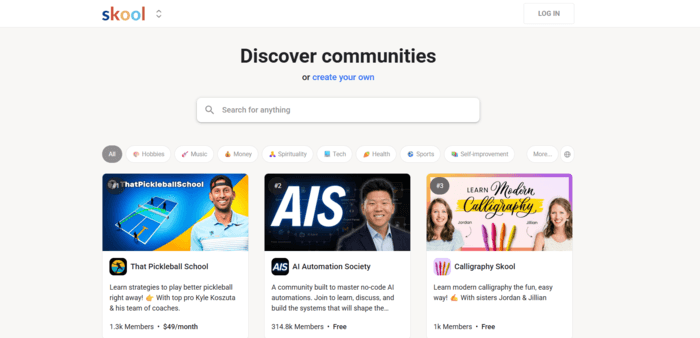
The Skool community appeal is easy to understand. Everything sits in one place. Community posts, courses, calendar events, chat, and member management are all built into a single system rather than split across multiple tools. Its pricing follows the same approach, with unlimited members, courses, videos, and live calls included.
In practice, the setup is straightforward. Members move between the Skool community feed, the Classroom, and the Calendar without much friction.
The mobile app mirrors these core community features, including posts, lessons, events, and chat.
For creators, there’s a clear path to selling courses, organising discussions into categories, setting access rules, and using points and levels to guide participation.
The structure is fairly fixed. That keeps things clear, but it also limits how much you can shape the experience. Engagement tools are there, but activity still depends on how the creator drives conversation and keeps members involved.
The gamification system, however, tends to focus more on quantity than quality which translates to more of a focus on competition and streaks rather than the actual depth of engagement.
The overall setup leans toward structured learning, which works well for course-led communities but can feel more classroom-first than community-building-first, depending on what you’re building.
Mighty Networks Overview
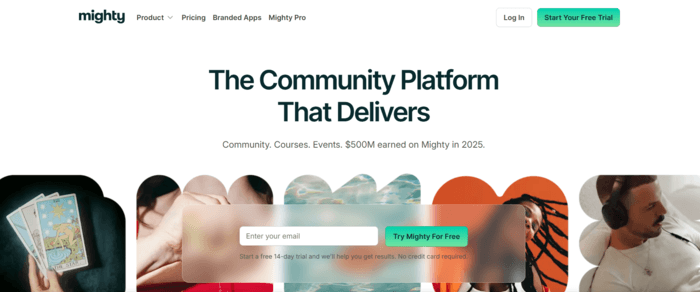
Mighty Networks offers a different approach. It gives you more control over how your community is structured, how it looks, and how different types of content are organised.
You can build out spaces for discussions, Mighty Network apps, courses, events, native live streaming, and memberships, all under your own branding, with options to customise layouts and navigation.
Flexibility is one of its main strengths. If you want to create a more tailored experience or run multiple community segments within one platform, Mighty Networks gives you the tools to do that. It also scales well, particularly for larger communities or businesses that want to bring content, community, and monetization together under one system.
Might Networks puts more responsibility on how the space is set up. Structure, content, and member flow are all defined by native video hosting, so the experience reflects those choices. When that structure is clear, everything works as expected. When it isn’t, the community can feel spread out, with no clear path for members to follow.
Skool vs Mighty Networks: Which One Should You Choose?
At a glance, both platforms can do the job, but they lead to very different setups.
The Skool platform fits best when you want something simple and structured. It’s a community platform at its core, so it works well when creating a community around your content is the main focus and discussion supports it. Setup is quick, the layout is clear, and there’s very little to figure out once you’re in.
It also keeps things contained. There aren’t multiple spaces to manage or design decisions to make, which suits creators who want to focus on delivery rather than structure.
Mighty Networks sits on the other side of that. It gives you more control over how everything is organised, from content to community spaces to branding. That opens up more possibilities, especially if you’re running a larger or more layered setup.
At the same time, it puts more weight on how well the space is put together. The experience depends on how clearly everything is structured and how easy it is for members to move between areas.
Both platforms can work well. In both cases, though, activity doesn’t happen on its own. The platform supports the setup, but the energy in the community still comes from how it’s run.
Why Engagement Feels Different on Swarm
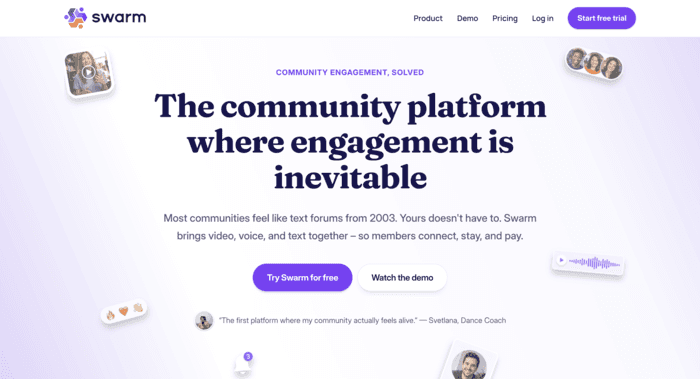
By this point, there’s usually a pattern. The platform gives you the structure, but keeping people active still takes effort. Posts need prompting, conversations need nudging, and momentum doesn’t always hold.
Swarm is built to reduce that load. The experience is more contained, so members don’t have to think about where to go or what to do next. Interaction doesn’t rely on long threads or constant posting. It’s easier to show up, respond, and stay involved.
The difference is how that adds up over time. Unlike Skool and Might Networks, activity builds more naturally, without needing the same level of input to keep things moving.
It comes back to three areas: how easy it is for members to show up, how interactive elements actually feel, and how participation is recognised once they do.
#1 Make it Easy to Show Up
Swarm lowers the effort it takes for members to take part. Community, course creation, events, payments, gamification, members, and branded app access all sit within one platform, so people are not bouncing between separate tools to stay involved.
Swarm also supports video, voice, and text together, which gives members more than one way to respond depending on what feels quickest in the moment.
On top of that, its AI features are designed to reduce friction rather than add novelty, with tools such as summaries, transcripts, response assistance, and recap features that help members catch up and re-enter the conversation without starting from scratch. The logic is simple, and it holds up in practice: if it’s easy to show up, people show up.
#2 Human Interaction is Key
Swarm uses video as a communication tool, not as a gimmick or a brand crutch. The point is not to turn every interaction into a polished recording. It is to bring back the tone, presence, and immediacy that usually disappear in text-first communities.
Swarm’s own positioning is built around that idea, with short asynchronous video messages sitting alongside voice and text so members can respond in a way that feels natural. That changes the feel of the space.
Faces and voices carry more context than a written reply, which makes conversations feel more direct and more personal. Even when only part of the community uses video regularly, it can
raise the energy of the wider space and make participation feel more human.
#3 Reward Meaningful Participation
Swarm’s gamification goes beyond a visible leaderboard. According to its help documentation, creators can configure points for actions such as likes received, replies received, and posts created, with bonus points available for video, audio, and text posts.
Levels and activity charts can also be shown or hidden, which gives hosts more control over how recognition works inside the space. That matters because it shifts the emphasis away from empty activity and toward contribution that actually adds value.
Used well, badges, levels, and points can give members a sense that their presence is noticed without turning the whole experience into a race. The result is a stronger form of retention, where recognition supports real interaction instead of pressuring members to post for the sake of posting.
How to Choose Your Platform
Both Skool and Mighty Networks give you the tools to run a community. Structure is there, content is there, and everything can be set up to work.
What they don’t fully solve is what happens after that. Keeping people active still comes down to how the space is run, how easy it is to take part, and how interaction develops over time.
Swarm is built around the experience. The focus is not on adding more features, but on shaping how members show up, interact, and stay involved once they’re inside.
The difference comes through in three areas: how simple it is to participate, how interaction actually feels, and how contribution is recognised over time.
Skool vs Mighty Networks vs Swarm: The Bottom Line
Skool vs Mighty Network: both cover the fundamentals. You can host content, build a community, and run a paid offering on either platform. The difference shows up in how much control you need and how much structure you want in place from the start.
Skool keeps things simple and contained, which suits course-led communities and quick setup. Mighty Networks gives you more flexibility and branding control, which works better for more complex or layered setups.
Across both, the same factor still sits underneath everything: engagement. The tools support the structure, but they don’t guarantee activity.
That’s the gap Swarm focuses on. The platform is built around how people take part once they’re inside, not just how the community is set up.
If member engagement is the priority, start a free trial with Swarm and see for yourself how you can build an organic community.
Skool vs Mighty Networks: FAQs
#1 What is the best online student community platform?
The best online student community platform depends on how the community is run. Some platforms focus on delivering content and mobile apps, while other platforms place more emphasis on interaction. A strong option is one that makes it easy for students to take part, respond, and stay involved over time.
#2 What should I look for in an online learning platform for students?
An online learning platform for students should be easy to navigate and support both content and interaction. Clear structure, simple onboarding, and the ability to communicate in different ways all make a difference. Platforms that reduce friction tend to see more consistent participation.
#3 How do you keep a student community engaged?
Engagement comes down to how easy it is to take part and how natural interaction feels. Communities stay active when members can respond quickly, follow conversations easily, and feel recognised for contributing. If participation takes effort, activity usually drops.