Community Platforms
Best Kajabi Alternatives for Communities and Courses in 2026
Looking for the best Kajabi alternatives for 2026? Compare top platforms for courses and communities, including pricing, integration, and video tools.

If you’re on the hunt for a dedicated platform for communities and courses, you’ve likely come across Kajabi. It’s a powerful tool that has helped thousands of creators turn their knowledge into structured courses, polished sales funnels, and real revenue.
For a lot of users, it’s the perfect fit. But for some coaches, mentors, or creators, it’s almost too much. Alongside feature overload, there is not enough focus on community for a lot of creators and users report experience feeling fragmented. Kajabi is focused on courses while not having as much of a focus on building community which is essential for small businesses.
One major selling point is its ability to function as an all-in-one business machine. It’s complete with marketing tools, automations, and features that go far beyond simply hosting a course or growing a community. While this reads great on paper, many users find themselves paying for functionality they rarely use, or navigating a system that feels heavier than necessary.
Alongside excess features, price is often part of the conversation. So is the complexity.
As you refine your search for a platform, it’s important to focus on tools that suit how you actually work and how your community engages. Once you’ve built workflows, uploaded content, structured courses, and trained your members to use a system, switching later becomes significantly more complicated. It can cost far more in time and disruption than the subscription fee itself.
This guide explores the strongest Kajabi alternatives for communities and courses in 2026. Each one supports structured learning, but the experience they create for you and your members can feel very different.
Why Creators Consider Kajabi Alternatives
Kajabi is built as a comprehensive business platform. While that breadth is a strength, it can also become a friction point.
Below are the most common reasons creators begin exploring Kajabi alternatives.
#1 Price Relative to Usage
Kajabi’s pricing reflects its all-in-one positioning. For creators who actively use its funnel builder, email marketing, automations, and advanced features, the cost may be justified.
For others, especially those primarily building a community and a course, the price can feel high for tools they do not fully use.
#2 Feature Overload
A key benefit of Kajabi is its ability to support full-scale digital businesses. That means dashboards, pipelines, marketing settings, and automation layers. But not every creator needs this level of detail.
If your primary focus is delivering structured lessons and hosting meaningful discussions, navigating a broad marketing system can feel unnecessary.
#3 You Want a Different Style of Interaction
If your community model depends heavily on face-to-face interaction, live sessions, or asynchronous video discussion, it’s worth comparing platforms based on how they support those workflows in practice. Kajabi offers a wide set of tools, but different platforms emphasize different interaction styles.
#4 More of a Focus on Community
Kajabi is not built for communities and is at its core a coure-platform. This is why creators and users often report a very fragmented experience. An example of this in action is how they have two separate apps- one for community and one for courses.
Control vs Simplicity
Kajabi is a serious business platform with real depth, but it’s not the ultimate tool for every creator or business owner.
Before settling on any system, get clear on what you actually need. Then, find platforms built specifically around those functions rather than a broader business stack.
Next, we’re going to help you identify your needs, diving into the key features of the top Kajabi alternatives.
What to Look for in a Kajabi Alternative
Although price is an important factor, when exploring Kajabi alternatives, the goal isn’t to find “cheaper” or “easier.” Rather, you need to find platforms that align with how you deliver value to your customers.
Here are the areas to focus on when making comparisons.
#1 Pricing Model vs Feature Scope
When comparing Kajabi alternatives, look at what you’re actually paying for. As mentioned, Kajabi’s pricing reflects an extensive platform, but some of its features may not be necessary for you.
Some platforms focus primarily on course delivery. Others center on community. Others bundle marketing infrastructure. The key question is not “what has more features,” but whether the feature set aligns with what you are actively using.
A lower price only makes sense if it doesn’t remove functionality you rely on.
#2 Course and Community Integration
Kajabi allows creators to sell courses and build communities, but the way those two experiences connect can vary across platforms.
When evaluating alternatives, assess how tightly learning and discussion sit together. Can members move naturally between structured content and conversation? Does the platform support interaction around lessons without feeling fragmented?
Creators often report Kajabi as being fragmented when it comes to community with separate apps for courses and community. While it works well as a course-focused platform, users often feel there is not enough of an integration between the learning and community side.
For creators whose value extends beyond pre-recorded modules, this integration becomes important.
#3 Video Capabilities
This is often overlooked in high-level comparisons.
If your model includes live calls, workshops, or feedback sessions, examine how video is handled. Is live video native to the platform or dependent on external tools? Are replays embedded within the member experience? Can interaction extend beyond text-based comments?
For coaches, educators, and creators who rely on presence and nuance, video functionality is not a minor detail. It directly impacts retention and engagement.
#4 Platform Scope and Complexity
Kajabi is intentionally broad. It includes marketing automation, funnels, landing pages, and email systems.
When comparing alternatives, be clear about whether you want that same business-stack depth or a platform centered specifically on structured programs and member spaces.
Reducing system complexity can simplify operations. Expanding it can centralize your stack. The right direction depends on how your business is structured.
The 5 Best Kajabi Alternatives for Communities and Courses
If you’re determining community and course platforms seriously, feature lists alone won’t necessarily help. Most tools can host courses. Many can support communities.
The difference shows up in how those elements connect, how interaction is handled, and how the experience feels once members are using it.
Let’s take a look at five strong Kajabi alternatives for creators focused specifically on structured programs and engaged communities.
#1 Swarm
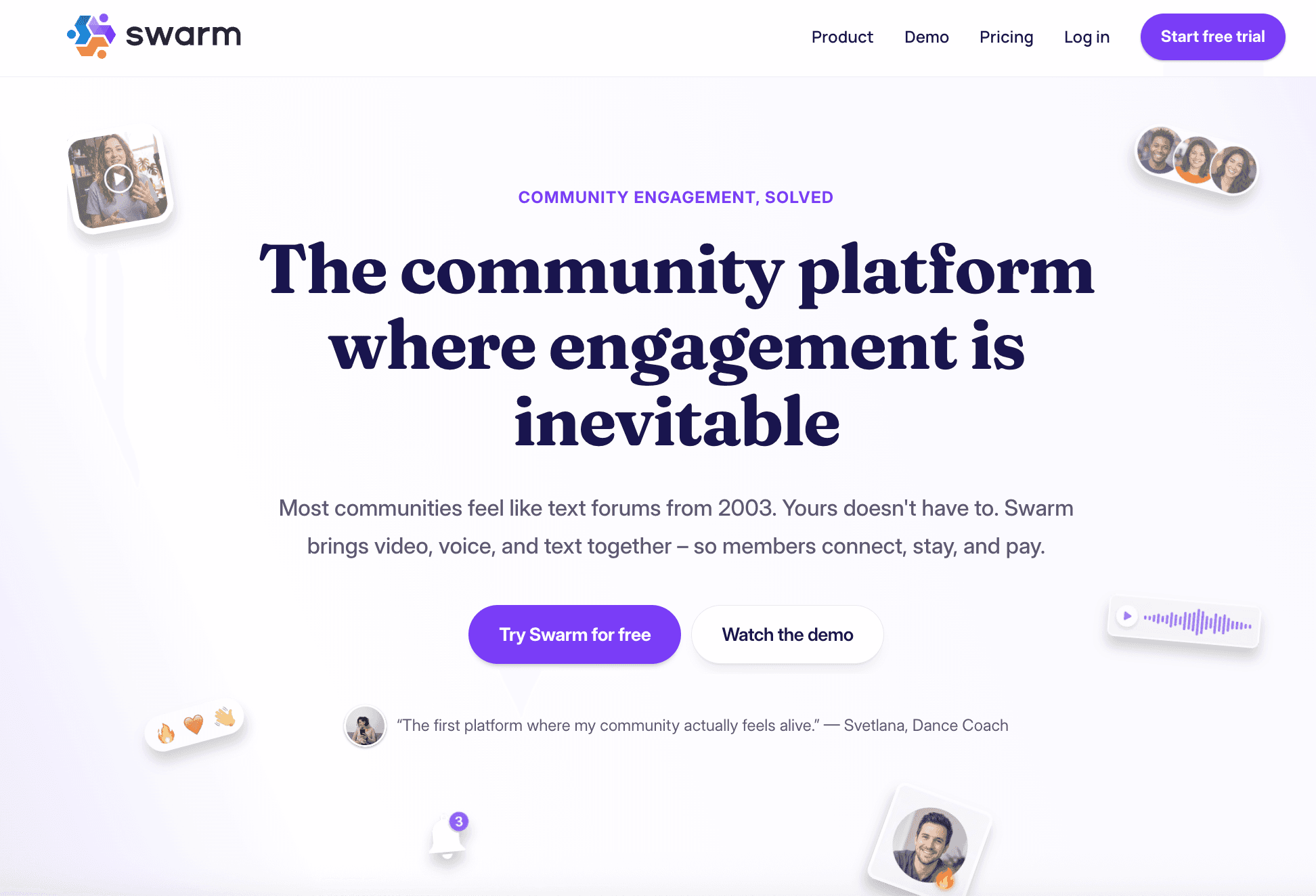
Swarm is built around a simple idea that online communities should feel closer to real interaction rather than static discussion boards.
Unlike traditional course platforms that layer community onto a content library, Swarm centers interaction around video and structured conversation. For creators who rely on presence, coaching, feedback, or live engagement, that architectural difference matters.
Platforms like Kajabi work well if you are looking for something purely courses-focused that simply needs to deliver that content. However, where a platform like Swarm excels is it focuses on courses as a community experience.
Peer discussion and accountability drive completion rates in a way that platforms like Kajabi cannot compete with. Alongside this, discussion hubs are built into every course- they are not ‘add-ons’ but rather an important part of each learning experience.
Video replies within course discussions encourage community growth. This is encouraged further with features like voice note responses for quick personal feedback and peer accountability through visible participation.
Instead of having separate apps for community and learning, Swarm focuses on keeping the learning and community in one space.
Key capabilities include:
Drag-and-drop course builder: easy to use course builder that allows for multiple formats, including video and PDFs.
Active learning: submit homework for feedback, include quizzes at any point and shareable certificates. Members learn by doing, not just watching.
Community-powered: discussion hubs built into each course so members can have discussions, share progress and celebrate wins. Community is integrated into the course, rather than being a separate section.
One-stop shop: sell everything from one place - memberships, courses, live events, coaching sessions. One tool for everything you need.
Mobile app: your members can access your content from anywhere and at any times.
Customization: make your space fully yours with your own branding and custom domain.
Engagement that boosts completion rates: Swarm courses get finished — because peer accountability, visible progress, and community are built into every lesson.
Swarm is particularly strong for creators and experts who value a genuinely engaged community with high interaction rates. While most courses gather dust and sit unfinished, Swarm focuses on having courses completed with features like peer accountability, visible progress, and community built into the learning experience.
Swarm focuses on including video-based connections in their communities for this reason. This can mean live sessions with embedded replays or rich asynchronous video discussions. By structuring conversation around faces and voices, rather than text alone, Swarm aims to create deeper engagement and more authentic interaction.
Some negatives we see with other platforms, like a lack of customization, are addressed by Swarm through the ability to create a branded mobile app. You can also create your own unique domain and branding, which helps enrich customer experience.
#2 Thinkific
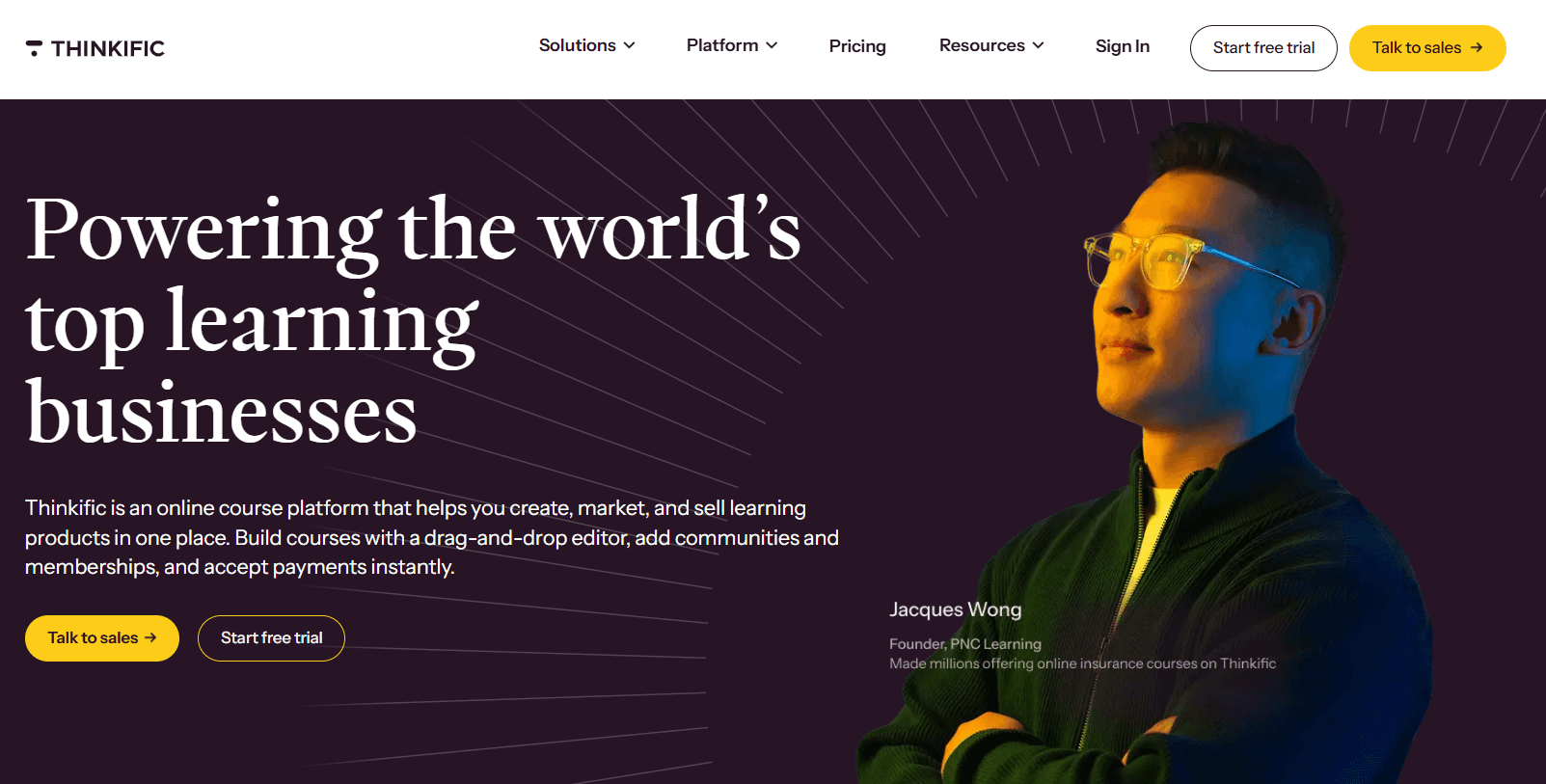
Thinkific is a learning commerce platform that combines course creation, community features, and monetization tools in one place. It’s built for creators, educators, and trainers who want to create and sell online products. This includes courses, communities, memberships, and digital downloads, under their own brand.
Thinkific’s course tools are centered around making online learning easy to build and manage without needing advanced technical skills. It also includes capabilities to build communities that are linked directly to learning experiences, allowing members to connect and engage in context.
Some of its core features include:
Drag-and-drop course builder: Create courses with an intuitive visual editor that supports video, text, and other media.
Integrated learning communities: Build community spaces that connect directly with course offerings and engage learners in discussion.
Monetization options: Offer courses, communities, memberships, and digital products from the same platform without needing multiple tools.
Flexible packaging: Price and sell communities as standalone products, bundle them with courses, or include them in membership offerings.
Mobile access: Learners can interact with courses and community posts via the Thinkific mobile app, including in-app notifications and activity feeds.
Progress and engagement tools: Track learner progress and support discussion around content to extend engagement.
Thinkific positions itself as a platform where learning and community can live side by side under the same branded experience, reducing the need to stitch together multiple tools.
#3 Mighty Networks
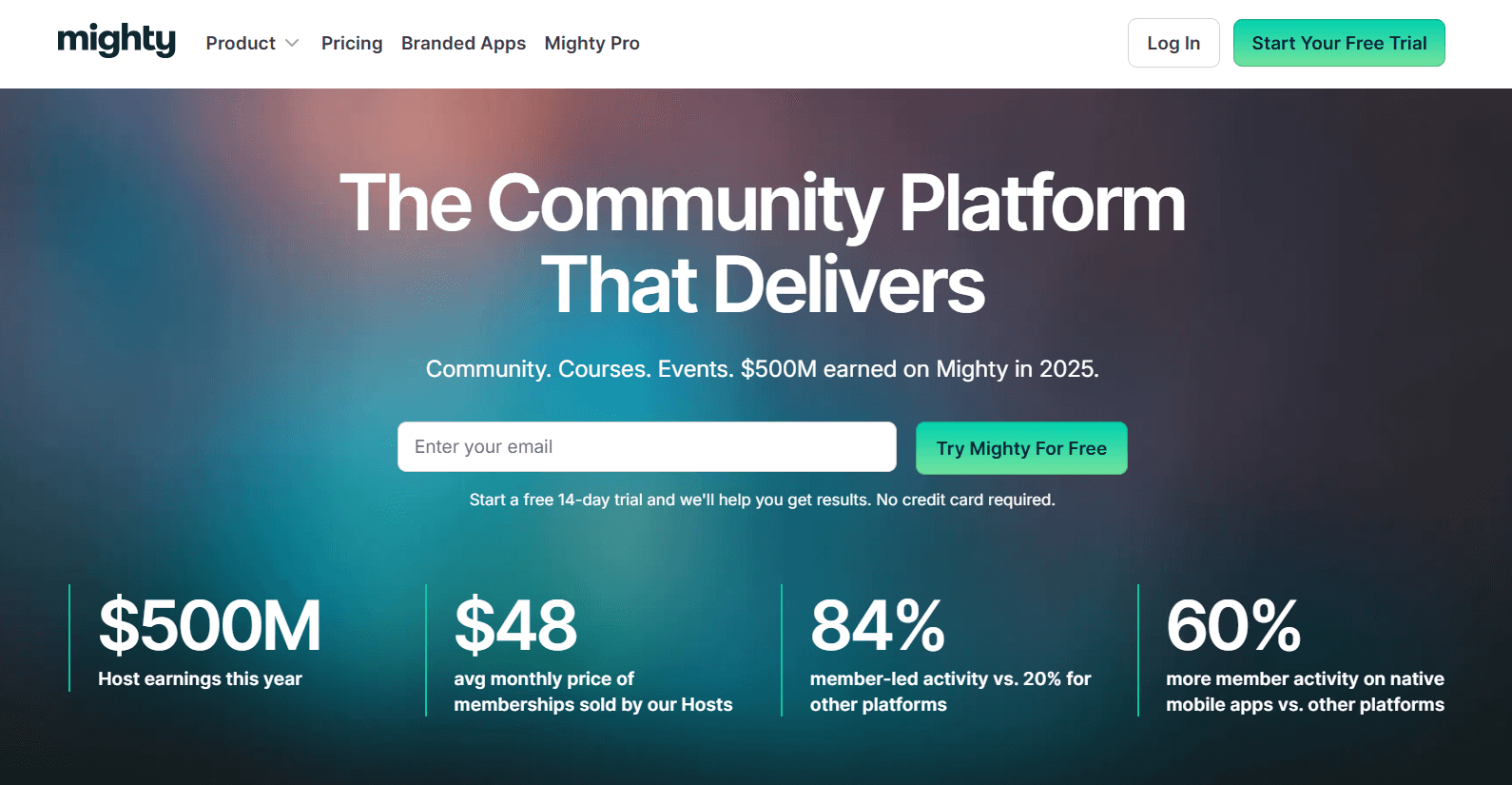
Mighty is a community-centric platform that also supports online courses, memberships, and events, all within the same environment. The platform is designed to help creators build both structured learning and active cohort-style communities without fragmenting those experiences across separate tools.
Below are some of the most important features for creators:
Native community tools: Create feeds, polls, questions, and direct chat, plus livestreams and events to keep members connected.
Built-in course creation: Courses can be created with lessons, sections, quizzes, certifications, and progress tracking.
Drip and scheduling controls: Release lessons on a schedule or unlock content as members progress through a course.
Habit trackers, challenges, and resource libraries: Flexible content options extend beyond classic courses to support engagement and accountability.
Unlimited spaces and member features: Organize your network with multiple topic or cohort spaces, plus custom fields and tags to help members connect.
Monetization within the same community: Sell access to memberships and courses from one platform.
Mobile access: Members can interact via the native apps on iOS and Android.
Mighty’s course and community tools are built to work together rather than in separate silos. For example, courses live inside the broader network, and members can participate in discussions, interact with polls and questions, or join live sessions without navigating to external tools.
Overall, Mighty emphasizes an integrated environment where community and learning coexist in one place. This makes it a strong choice for creators who want to blend structured education with an ongoing social experience.
#4 Podia
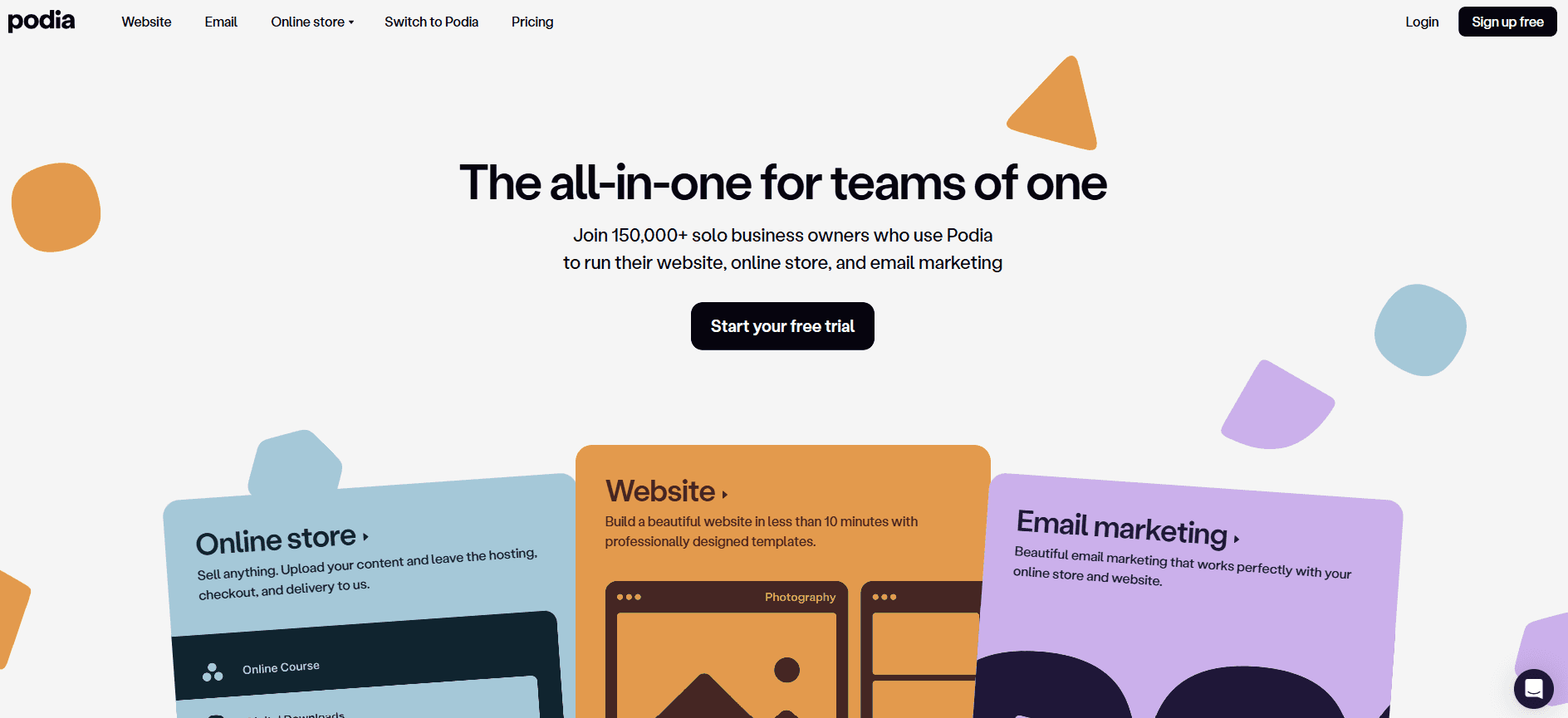
Podia portrays itself as an all-in-one home for business owners’ websites, products, and email marketing. It supports online courses, memberships, and community features, with built-in tools designed to help creators sell and promote those offers from one dashboard.
Rather than separating marketing from product delivery, Podia integrates them. Creators can build landing pages, send email campaigns, sell digital products, and manage memberships without connecting multiple systems.
Some of the main benefits of choosing Podia are:
Built-in email marketing: Send newsletters and automated email campaigns directly connected to your products and audience.
Website and landing page builder: Create branded pages and sales funnels within the same platform.
Online course hosting: Deliver structured lessons with multimedia content under your own branded site.
Community feature: Create free or paid member spaces where users can post and interact alongside course content.
Flexible product types: Sell courses, memberships, and digital downloads from one dashboard.
Sales tools: Use coupons, bundles, and upsells to support monetization strategies.
Podia is structured around helping individual solo creators or entrepreneurs run a unified business. Courses, email campaigns, sales pages, and community spaces all operate within the same system, reducing the need for additional marketing software.
#5 Skool
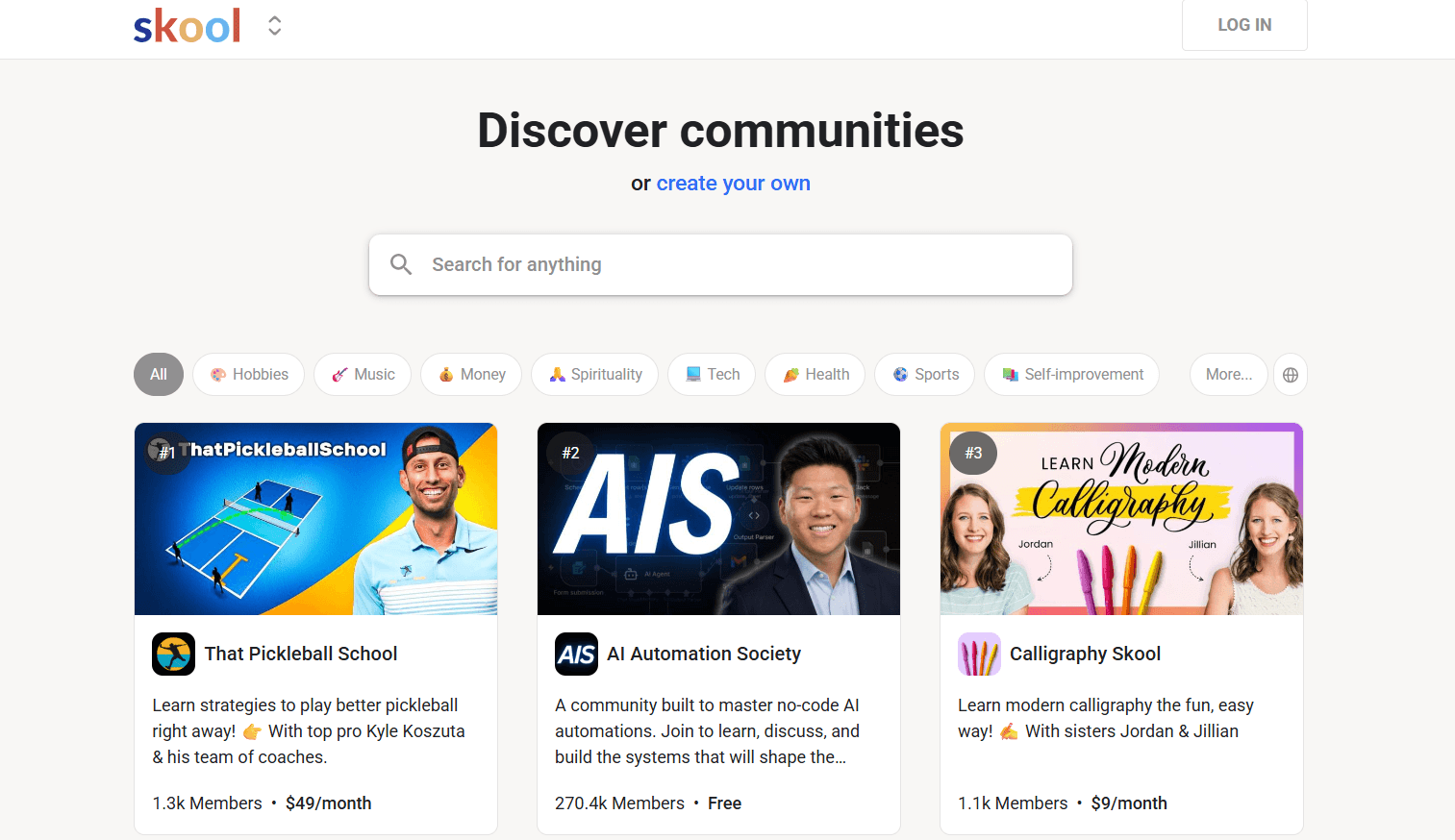
Skool combines courses and community inside a single group-based environment. Each Skool group contains three primary areas: a community feed for discussion, a classroom section for structured course content, and a calendar for live sessions and events.
Some of its core features include:
Classroom section: Add structured lessons and course materials directly inside the group environment.
Community feed: Members post and comment in a centralized discussion space tied to the group.
Calendar and events: Schedule and display upcoming live calls within the platform.
Gamification system: Built-in points, levels, and leaderboards designed to reward participation.
Flat monthly pricing model: One subscription fee per group with unlimited members and no additional transaction fees, as outlined on Skool’s pricing page.
Mobile access: Members can access groups through Skool’s web and mobile experience.
Skool’s structure keeps learning content and discussion inside the same interface, without separating them into distinct product areas. Its built-in engagement mechanics and simplified pricing model differentiate it from broader business-stack platforms.
Choosing the Right Kajabi Alternative
Kajabi continues to serve creators who want an all-in-one business platform with marketing infrastructure and product delivery under one system.
But not every business is built around funnel depth or automation layers. Many are built around programs, conversations, and ongoing engagement.
When courses and community sit at the center of your model, the experience inside the platform matters more than the breadth of the business stack around it.
How members interact.
How discussions unfold.
How live sessions and replays are handled.
These details shape retention and long-term value.
The Kajabi alternatives outlined above approach that experience differently. The differences are structural, not cosmetic.
If your work depends on structured programs combined with meaningful interaction, an engagement-focused platform like Swarm, is worth exploring in practice, not just on paper. Its architecture is designed around that dynamic.
Platforms like Kajabi struggle with balancing community engagement and content, Swarm’s main focus is integrating community into every step of the learning process. This is done through features like video responses, peer discussions, and gamification.
We focus on member-first approaches with clear pathways and simple onboarding. This is tied into our video-focused approach that encourages member participation. Swarm also uses leaderboards, badges, levels, and activity charts as well to encourage quality participation.
The key difference between the way we do this versus other platforms that have gamification is Swarm rewards quality interaction versus simply having a point-based reward system.
The best way to evaluate it all is to step inside and feel it out for your own brand.