Community Platforms
8 Best Private Online Community Platforms for 2027 (Compared)
We compared eight online community platforms for private, members-only groups by features, pricing and fees, so you can pick the right home for your community.

The best online community platforms in 2027
Best for coaching and expert-led communities: Swarm, from $19/month billed yearly
Best for a simple, low-cost start: Skool, from $9/month (10% transaction fee)
Best for customisation and automations: Circle, from $89/month billed yearly
Best all-in-one for networks: Mighty Networks, from $79/month billed yearly
Best for courses plus marketing tools: Kajabi, from $143/month billed yearly
Best for course-first businesses: Thinkific, from $40/month billed yearly
Best for brand and customer communities: Bettermode, from $149/month billed yearly
Best for large organisations and alumni networks: Hivebrite, from $895/month billed annually
Communities thrive because of engagement. That is especially true with online communities.
But how do you engage best? Which websites and applications are great for community building?
We've updated this guide for 2027 with current pricing, transaction fees and a comparison table, plus free options and what to look for in online community software. Private online community platforms are all-in-one tools that help you engage members with discussions, courses, virtual events and video. Finding the right one is the tricky part. There are many options, and not all fit every business. Below are eight strong choices, compared side by side.
What Are Private Online Community Platforms?
Private online community platforms are digital spaces open only to select members. They give like-minded people a place to connect and take part. To join, people usually need an invite, an application or a paid membership.
Public vs private online communities
The two main types are public and private. Public communities, like open Facebook Groups, subreddits or forums, let anyone read and join. Private communities limit who can get in. Private communities tend to have fewer members but deeper conversations, because people know who they are talking to.
What to look for in online community software in 2027
Online community software is the platform your members log in to: where they talk, learn, meet live and pay you. Most tools now cover the basics, so the differences that matter are in how members actually take part. Before you pick one, check these seven things:
How members communicate. Text-only feeds make it easy to lurk. Look for video, voice and text replies, threads and direct messages.
Live events. Can members join a live session from inside the community, or do you have to send out a Zoom link every time? Are recordings saved for people who missed it?
Courses. Can you build lessons with video, text and files, set the lesson order, and let members discuss each lesson?
Payments and fees. Check the transaction fee on each plan, not just the monthly price. A 10% fee on a $9 plan costs more than a $79 plan once your community earns enough.
Branding. Custom domain, your colors and logo, and whether you can have your own app or members have to download the platform's app.
Privacy and roles. Private spaces, member approval, and roles for moderators and admins.
Price as you grow. Look at member limits, the number of spaces, and what the next plan up costs.
Paid memberships are already common. Circle's 2025 Community Trends Report found that 54% of respondents were already tapping into paid memberships, and 41% were using recurring subscriptions, alongside offerings like coaching and courses. Dedicated platforms also stick around: CMX 2025 Community Industry Report found that more than half of communities surveyed had existed for five or more years.
| Platform | Best for | Starting price | Transaction fees | Your own branded app |
|---|---|---|---|---|
| Swarm | Video-first coaching and creator communities | $19/mo billed yearly ($29 monthly) | 5% on Launch, 0% on Growth and Scale | Scale plan, $149/mo billed yearly |
| Skool | Simple, low-cost communities | $9/mo | 10% + 30c on Hobby, 2.9% + 30c on Pro | Not offered (members use the Skool app) |
| Circle | Customization and automations | $89/mo billed annually | 2% Professional, 1% Business and Scale, 0.5% Circle Plus | Circle Plus, custom pricing |
| Mighty Networks | All-in-one networks | $79/mo billed annually | 2%, 1% or 0.5% by plan | Mighty Pro, by quote |
| Kajabi | Courses plus marketing | $143/mo billed annually ($179 monthly) | No Kajabi revenue share; card processing applies (2%, 1% or 0.5% with a third-party processor on Basic, Growth or Pro) | Included on Pro |
| Thinkific | Course-first businesses | $40/mo billed annually | Thinkific Payments about 2.9%; third-party gateway fees vary by plan | Add-on, $199/mo (included on select Plus plans) |
| Bettermode | Brand and customer communities | $149/mo billed yearly ($199 monthly) | Not listed on the pricing page | Not listed on Starter |
| Hivebrite | Large organizations and alumni networks | $895/mo billed annually | Not listed on the pricing page | Available as an extension |
Prices checked October 2026. Check each platform's site for current pricing.
The 8 Best Private Online Community Platforms
While there are dozens of options, these eight are truly the best. To break it down further, we used the criteria from above.
Swarm

Some of the companies that trust Swarm include National University, ThriveDX, vidlQ, among others.
What sets Swarm apart is its focus on moving away from the traditional model of text-based, faceless communication.
Asynchronous video communication instead of conventional chat-based community groups like the ones we have gotten used to using Slack for work is the main medium of communication.
Members can create short videos to get their message across and others can see the video messages on their own time.

Why is this important?
Let us use an example from one of our most popular creator types:
From a personal trainer coaching perspective, you can see a member perform an exercise over video without scheduling a cumbersome Zoom call to explain precisely how to perform this specific exercise.
This extends to other creator communities as well- video messages allow for deeper conversations that save time by being asynchronous.
The asynchronous aspect also allows the videos to live on in your community, so the advice you give specific members in response to their video messages can be accessed by other members using the searchable video feature.
You can also manage who your messages are going to by using the private DMs feature to message community members privately or create smaller private groups to address concerns that might be unique to certain community members.
User-Friendliness
While Swarm is newer to the game, many clients find it not only compares to its competitors but works better for them than the platforms they were using. Being a smaller company means more focus on our customers because we prioritize support.
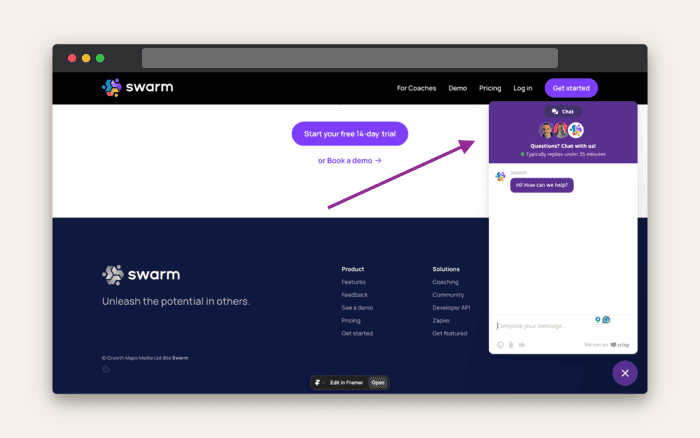
While we have tried our best to make the platform as easy to use as possible, any questions that might arise are only a chat support message away from being answered, and we typically reply in under 35 minutes.

Beyond that, the first time you create an account, you will be greeted with a checklist to get through, which will help set you up for success.
It also gives you a place to start when creating your community.
We understand that it can be overwhelming at first, so the checklist provides a step-by-step approach to setting things up.
The left-hand side panel contains a list of ‘hubs’ that allow you to quickly switch between community discussions, your member directory, and your list of announcements.
At the bottom of the panel, you can see icons that can be selected to open your messaging tab, your ‘set aside tab’ where you can bookmark specific messages to handle later, and an activity tab that summarizes what is going on in your community.
From the perspective of your members, it is equally easy to maneuver between different hubs- they just have different access levels depending on the role you assign to them (admin, moderator, or mentor).
There are also apps available to members and community creators alike to access the platform on the go.
Here's an independent look at how Swarm compares to the other platforms on this list:
Features
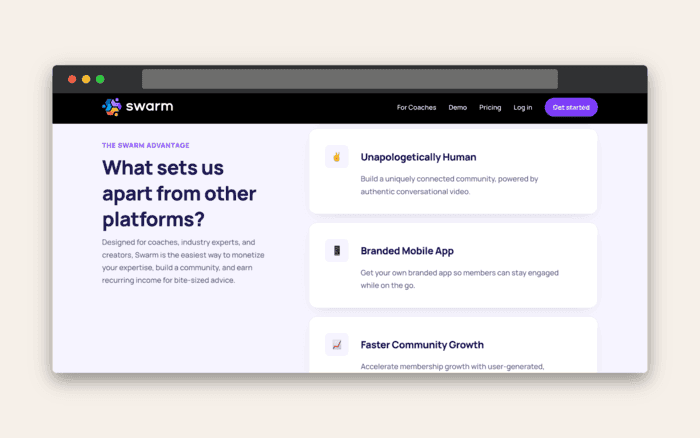
Some features that might be particularly useful to potential users and are worth pointing out would be:
Live video: You can host live events and then auto-post recordings of those videos for any members that might not have been able to tune in live.
Organized messaging: Threaded video, screen, audio, or text discussions around topics make it easier for everyone to keep track of what is being discussed.
Screen sharing: Beyond just recording your screen and face at the same time, you can also reposition your face in real-time and toggle between your screen and face depending on what is being said.
Mobile app: A branded app can be created to increase your professionalism and help grow your brand among members.
Private messages: You can use video, audio, or text messages to have private conversations 1-on-1 or in a group with specific members for better control over communication.
AI integration: An AI assistant is built in so you can more effectively understand members’ questions and craft responses if needed.
Member polls: Polls are pretty self-explanatory- you can create them to ask members their views on specific topics and increase engagement within your community. This is also particularly useful when running a coaching business- polls can help you clear up any potential doubts or clarify common doubts for members.
Auto-transcribed: All audio and video conversations are automatically transcribed for members (and your own team) to recap at any point in the future.
Bookmark what is important: Your bookmarked list of questions works as a to-do list. Members sending over questions all at once can be overwhelming, which is why the bookmark feature exists. It allows you to bookmark something that requires more attention for later, and you can then come back to it when ready.
Pinning posts: Important information sometimes gets lost in long conversations. During those times, you can use the pinning feature to highlight important information for your community members.
Branding: Swarm allows you to use your own domain and branding to streamline your brand and create a more professional image to display to your community.
Spaces for communities: While running multiple communities, spaces keep everything in order. Each space is a dedicated place for a specific community.
Stripe integration: You can easily connect your Stripe account to accept payments for memberships all within the platform, and we do not take any additional fees or cuts from what you earn.
Pricing
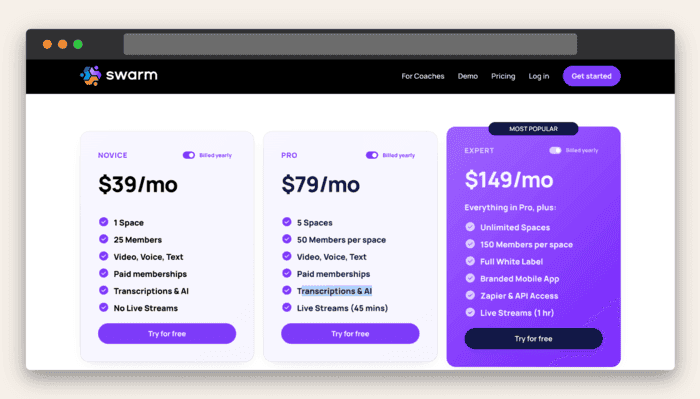
Swarm pricing starts at $39 and goes up to $339 per month (these are the prices when you pay yearly).
The main difference between different pricing models is the number of spaces and members that can be added so this depends on how big your community is or how many communities you have.
The higher pricing tiers also offer a branded mobile app for communities, Zapier, and API access, as well as longer live stream capabilities.
The most extensive plan also includes concierge setup and onboarding, a dedicated success coach, and early access to any new features that are unrolled to users.
Compared to other platforms like Mighty Networks, Swarm is more wallet-friendly, which might be an important factor for some potential users to consider when making their final decision.
Mighty Networks
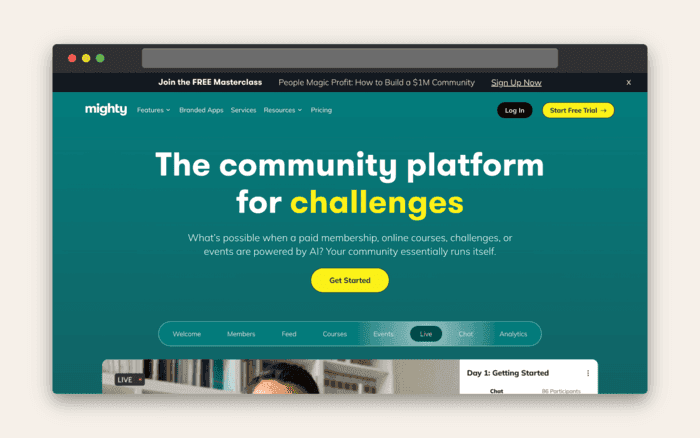
Mighty Networks is one of the older private community-building platforms on the web, and it has over a decade of experience. Hundreds of well-known companies use Mighty Networks' services, including Mindbody, TED, KonMari, Athletic Brewing Co., and Keap.
User-Friendliness
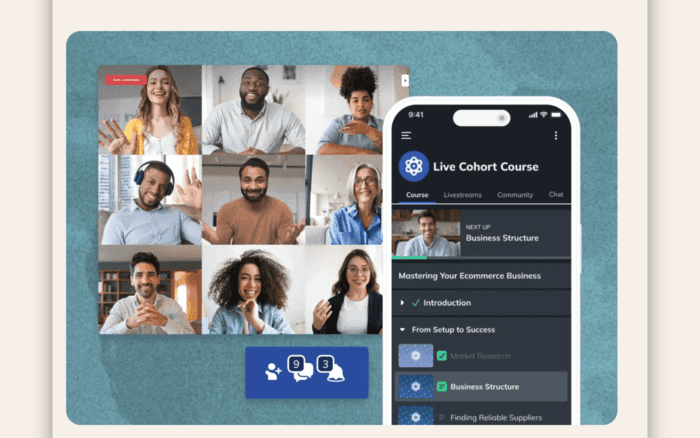
Mighty Networks couldn't be easier to use and understand. This incredibly smooth online community-building platform allows you to build courses and schedule live sessions effortlessly.
The online courses don't require years of coding knowledge. Instead, all you do is upload the content you want to display.
Navigating your home page as a user and community builder is even easier. Everything is clearly displayed and at your fingertips.
Courses, discussion posts, chats, and more are all on the left side of your screen. Really, you could master onboarding in just mere hours.
It's friendly not just for the community builder but also for the paid members.
Community members can easily access video content, courses, and virtual events all in one platform.
Mighty Networks is available online and on mobile apps for iOS and Android.
Features
The features available on Mighty Networks can feel endless. Not only is this flexible online community available on the web and in mobile app form, but it allows for a thriving community using community spaces.
Some unique features Mighty Networks has are:
Virtual courses with quizzes and polls
Live and asynchronous learning
Push notifications on courses and live events
People magic AI
Unlimited members
2,000+ embedding options
Customizable communities
Effortless live streaming
Private groups
Pricing
Pricing is where it gets tricky. While Mighty Networks has a powerful community-building platform, it isn't the cheapest option.
Plans start at $41 a month (when billed annually) but easily reach past $500. The cheapest plan is the Community Plan, which doesn't allow you to create online courses.
The next most expensive plan is the Courses Plan at $99 a month. It features courses, challenges, and less restrictions on community building.
Listed as the most popular option on Mighty Networks' website, the Business Plan is more interactive and costs $179 a month. This option makes live streaming easier, as you can stream for 30 hours a month.
Last but not least is the most expensive Mighty Networks plan, The Path-to-Pro Plan. When billed monthly, you can expect to pay $430 a month.
Hivebrite
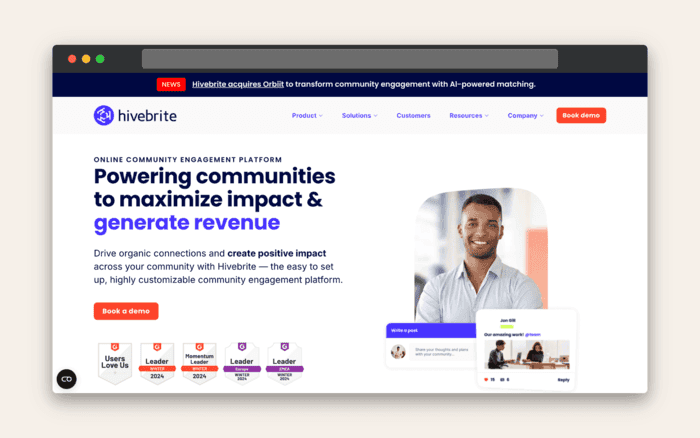
While not as well-known as Mighty Networks, Hiverbrite is an excellent option. Hiverbite focuses on organic growth and community engagement.
This all-in-one community platform solution is engaging, innovative, and flexible.
Hiverbrite lets you create and stand out with a unique URL and mobile app. So much of the community is also customizable, but we'll dive further into the features later.
Companies that have worked with Hiverbrite are the Harvard Business School, Shell Alumni, WWF, Yale, University of Notre Dame, and JA Worldwide.
User-Friendliness
Hiverbrite doesn't take much time to get used to. After onboarding, give yourself an hour to play with the settings, and you'll start creating your community in no time.
This online community platform is easy to use. The features are conveniently displayed, meaning you don't have to spend hours in frustration searching for your community's settings.
Customizing your visual identity in your community is a piece of cake. You can change your font style, color, and community logo.
Apart from this, creating online courses doesn't take long. Hivebrite provides pre-defined templates to quicken the process and help you stay consistent.
Features
Hiverbrite has unique key features, making it a great option regardless of your community.
Most community platforms have chat, forum, and website builders, but do they include live translating?
Here are a few key features Hiverbrite provides users:
Built-in social sharing buttons
Resource libraries
Virtual and in-person event creation
Customized landing pages
Mentoring connection tools
Systems-generated reminders
Pricing
If you are a beginner looking to learn about community platforms and how they can assist you in engaging with members, you might want to look elsewhere. Hiverbrite's price point is high and varies a lot.
Exact pricing for each plan is not available. If you'd like a quote, you'd need to contact Hiverbrite to book a demo.
According to their website, their most basic plan is the Connect plan. This plan memberships, resource libraries, and custom landing pages.
The next level is the Scale plan. With this plan, you also get access to ticketed events, group admins, and customized user access.
The last and final plan is the Enterprise. This plan includes the most out of all like advanced onboarding and specialized assistance.
Thinkific

Have you ever heard of Thinkific? This community platform is very interactive and helpful.
It helps community builders create courses, applications, and events quickly, freeing up time so they can focus on more important things.
User-Friendliness
Creating a high-converting landing page has never been easier. Thinkific uses AI tools to write and optimize landing pages. It just takes a few clicks.
You also don't have to go in blind. If you don't already have an idea of the overall style or format of your landing page, you can use one of the many AI-generated modern templates.
Course building is just as effortless with this online community tool. Thinkific provides a drag-and-drop course builder. Templates are also available, making life easier.
Features
Like most community platforms, Thinkific is filled with excellent engagement-driven features.
While using this one platform, you can create courses, landing pages, live virtual events, and more.
So, what makes this community-building platform stand out?
Live streaming and Zoom options
Automatic completion certificates for students who complete lessons/courses
TCommerce
Email automation
Specific analytics
Solo membership sites
Group Coaching
Resource Center and Webinars perfect for getting started
Pricing
Thinkific is one of the more affordable community platforms. The basic plan starts at $36 a month, but can also be paid annually at $156.
For a basic plan, it offers a lot. For instance, this plan includes unlimited courses and access to the website builder.
The next plan is called Start. It's about $40 more a month and includes unlimited digital downloads and memberships.
If you're looking to grow fast, Thinkific offers the Grow plan, starting at $149 a month. In this plan, you are bumped up to 3 communities.
The last plan, Thinkific+, is for serious and large business. You'll need to call and book a demo or ask for a quote. The price will vary depending on the services included.
Skool
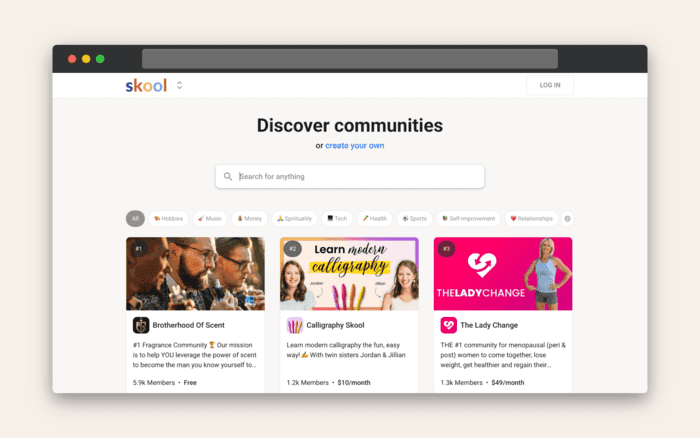
Another one of the best online community platforms is Skool. It's an interesting and unique platform that allows users to sell courses and create engaging communities.
Skool, though, is not as interactive, customizable, or as large as some of the other options on this list.
User-Friendliness
Creating and discovering communities and courses in Skool is easier than you'd think. Uploading content only takes seconds and you have free range on how to price your courses.
It's very user-friendly, so potential students won't have trouble finding courses or using them.
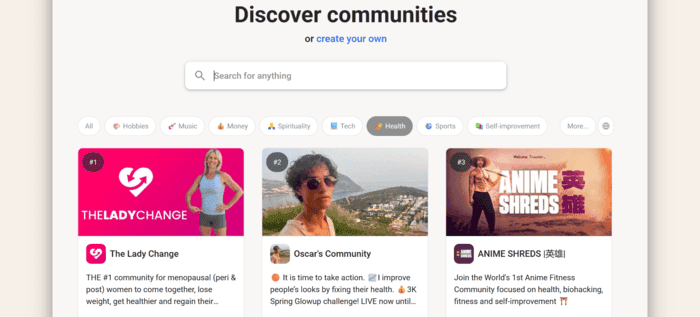
The front page of Skool divides courses by genres like health, self-improvement, spirituality, money, and more.
Features
Skool is a simple community platform, which also means it's limited compared to the others on this list.
Still, this platform includes,
Courses
Pages
Video content
Community posts
Polls
Gamification
Leadership boards
Metrics
Affiliate links
Pricing
When using Skool, you don't have to worry or think too hard about which paid membership program to choose. There is only one!
One plan includes everything. It's $99 a month, but Skool offers a two-week free trial to start.
This all-inclusive plan contains all features, along with unlimited courses and unlimited members.
Circle
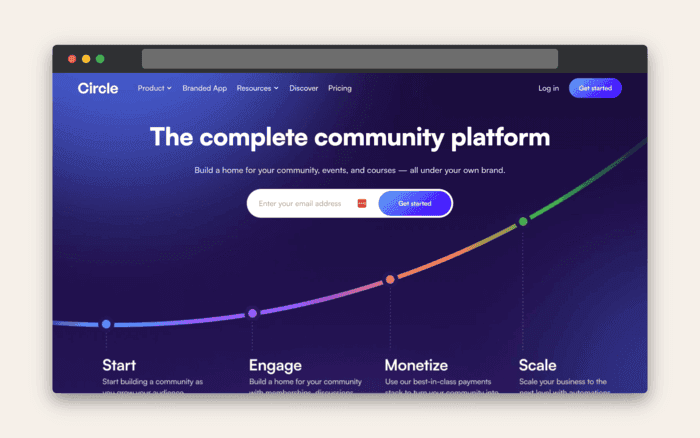
Launched just a few years ago in 2020, Circle is a great community platform with so many unique features and one of the easiest platforms to build on.
Circle has a lot going for it, frequently ranking on lists as a favorite for those interested in building communities.
More than 13,000 people use Circle with success stories coming from brands like Exit Fire, Income School, and Whoggga.
User-Friendliness
There is little to no learning curve when using Circle as a community-building platform. Building courses and customizing communities is simple and easy.
You don't need to learn code. Instead, Circle uses drag and drop. You can also upload video content, audio, text, and more.
Not only is it easy to use as a community builder, but it's also easy for students taking courses and community members.
Circle can be used both on computers as a website and as an app on iOS and Android.
Features
Circle isn't just easy to use, but it's also chock-full of useful features.
The key features to look forward to when using Circle are:
Creating multiple spaces
Live streaming
Clear analytics
Unlimited message history
SEO-friendly pages
Profanity filter for keywords
Award points and prizes to members
Email marketing
Pricing
The most basic Circle plan offered costs $89 a month. The basic plan, also known as the Professional Plan, works best for smaller businesses starting to scale up.
After the Professional Plan is the Business Plan. This plan is $199 a month and includes more features like workflows, admin API, activity scores, and branded email notifications.
For an extra $160 a month, you can snag the Enterprise plan. While currently on sale for $360, the website lists the Enterprise plan as high as $499.
A custom pricing option is also available. This price can reach past $500, but the exact number depends on what is included and the industry.
Kajabi
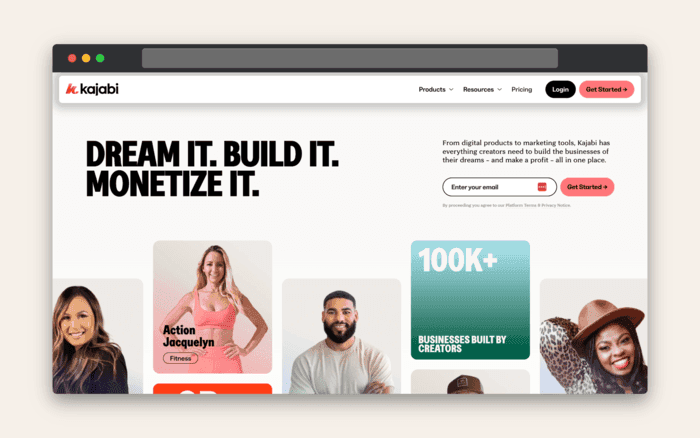
Kajabi is another community-building platform offering newsletters, communities, podcasts, courses, and more.
It's newer than the others on this list but is already a popular choice among creators looking to build community.
User-Friendliness
Kajabi earns a lot of points for its simplicity and user-friendliness. Whether you are a community builder or a student taking a course, Kajabi is easy to use and understand.
You won't spend hours searching for features on the website. Creating courses takes minutes, if not seconds.
Even if you're not sure how to structure your courses, Kajabi offers convenient customizable templates.
Communities in Kajabi are very customizable. You can set up a community name, upload a cover image, and set up a unique URL.
Features
While we briefly touched upon some features in the above paragraphs, Kajabi has more to offer.
Using this community-building tool, you can:
Join live Q and A workshops to learn more about the community platform
Livestream for hours
Set up meetings and webinars
Utilize a no-code web builder
Automate and scale campaigns
Pricing
Like any other dedicated community platform, Kajabi offers multiple plans to fit your needs.
On the lower end, Kajabi offers the Kickstarter plan starting at $89 a month. This plan includes one website, a product, and an online community. You also get access to 250 contacts.
The Basic Plan features more at a slightly higher price ($149). With this plan, users get 3 products and 10,000 contacts along with third-party integrations.
The Growth Plan is marketed as the more popular one. It's $199 a month but includes 15 products, 10,000 contacts, webhooks, and custom branding.
Lastly is Kajabi Pro which costs nearly $400 a month. With this, you can market up to 100 products and have 100,000 contacts.
Bettermode

Last but not least is Bettermode. Don't be scared, though, just because this is the last community platform on this list doesn't mean it's a bad one. On the contrary, it is one of the best online community platforms on the market.
Bettermode is an all-in-one platform that helps create an engaging and thriving online community. It's easy to use and understand.
A few companies that have used this product include ViewSonic, SmartSuite, Yoto Space, and Lenovo Legion.
User-Friendliness
Building websites and communities with Bettermode is very easy. They make it even simpler for you by providing website templates in various industries.
These templates are customizable and designed for engagement. They have templates for customer portals, developers, user forums, and more.
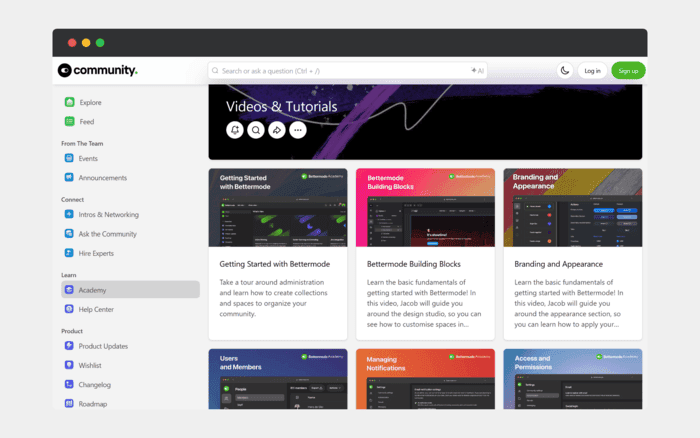
Bettermode wants to make it easy for clients to create communities. Because of this, they created the Bettermode Hub, which includes videos and tutorials.
Features
This platform has all of the features you need to successfully grow an online community. The features are highlighted on Bettermode's website in a clear manner.
Bettermode is especially known for its community spaces and collections that easily organize each community space.
Other incredible features are:
Social media login
Tags
Discussion forums
Website building using blocks (no code)
Mobile apps
Custom apps
Integration of many apps, including Slack
Reactions and comments
Private Messaging
Pricing
Bettermode offers a private free community platform plan called Starter. It doesn't include much but is a great way to get familiar with Bettermode's features before paying for a subscription.
With the Starter plan, you get 20 community spaces with up to 100 community members.
For unlimited members, you'll want to use Bettermode's Pro Plan starting at $49 a month. With this plan, you also get a custom domain and advanced analytics.
Enterprise is the last subscription available with Bettermode. There are no listed prices. Instead, you'll need to call sales for a quote and more information on the services you can add.
The best community platform for creators
If you are a creator or coach rather than a company, you need different things from a community platform. You are the teacher, host, community manager and CEO, so setup time and member engagement matter more than enterprise features.
If your teaching is visual or personal (fitness, dance, music, coaching, wellbeing), pick a platform where members can see and hear you and each other. That is what Swarm is built for: video, voice and text in the same thread, native live sessions and courses with discussion in every lesson. See Swarm for coaches.
If you want the cheapest possible start, Skool's Hobby plan is $9/month, but it takes 10% of what you earn. Read our Skool alternatives guide before you commit (when live).
If you want heavy customization and automations, Circle has the most options, starting at $89/month billed annually. Here are the best Circle alternatives if it feels like too much.
If you mainly sell courses, Kajabi, Thinkific and Podia lean towards courses and marketing over community. Compare them in our Kajabi alternatives and Podia alternatives guides. Podia itself starts at $42/month billed yearly with a 5% fee on Mover, or $84/$150 with 0% Podia fees on Shaker and Earthquaker (podia.com/pricing, checked 19 Oct 2026).
If you are moving from Mighty Networks, see our Mighty Networks alternatives.
Are there free online community platforms?
Yes, but free usually means you are trading control for cost. Facebook Groups and Discord are free to start and familiar to most people, which makes them a common first home for a community. The trade-offs show up as you grow: the platform decides who sees your posts, your members are one tap away from everything else on their feed, and you do not own the space or the member relationship.
If you plan to charge for access, run courses or host regular live sessions, a dedicated platform is usually worth it. Most paid platforms let you try everything free first. Swarm offers a 14-day free trial, no credit card needed.
A good way to use a trial is to invite five to ten of your most engaged people in and run one live session and one discussion before you decide.
How to build a private online community in 5 steps
Define who it is for and the outcome they want. "Beginner runners training for their first half marathon" beats "fitness fans".
Pick your platform using the checklist above. Start with one space, not ten.
Invite a small founding group. Ten committed members are better than fifty who never log in.
Make the first week count. Welcome every new member personally (a short video works well), and give them one useful thing to do on day one.
Set a rhythm. A weekly live session, a weekly prompt and a monthly challenge give people a reason to come back.
Wrapping it up
You do not have to build your community alone or across five tools. Private community platforms bring discussions, courses and events into one home you control.
Use the quick answer at the top as a shortcut: Swarm for video-first coaching and creator communities, Skool for the cheapest start (watch the 10% fee), Circle for customization, Mighty Networks for all-in-one networks, Kajabi or Thinkific when courses and marketing lead, Bettermode for brand communities, and Hivebrite for large organizations.
If your community runs on connection, try Swarm. Members reply with video, voice or text, join live sessions in one click and learn together in courses with discussion built in. Plans start at $19/month billed yearly.

