Success Stories
The conference-to-community strategy that drew 300+ members in 90 days
An inside look into how Ryan turned an annual conference into year-round impact and connection by building a free online community.

Sofia Guimarães
Marketing Manager at Swarm, writing about how creators & experts can build human communities that last.
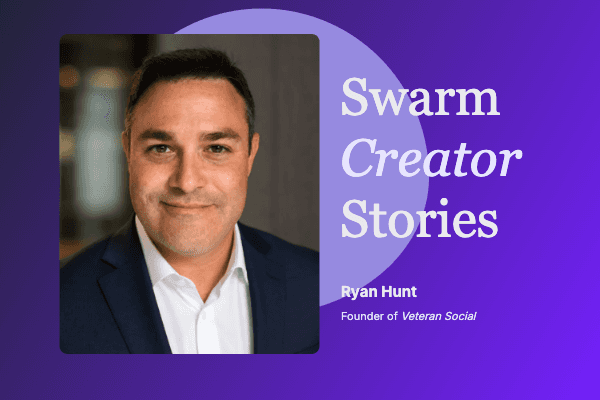
Ryan had a two-day annual conference and a 60,000-person mailing list. What he didn't have was anywhere for those people to connect for 363 days a year.
He wanted to create a space that kept the conversation going beyond the conference and where his audience could connect year round - and it turned out, his audience wanted the same.
Just 90 days after launching his online community, Ryan had more than 300 members and is on target to having over 1000 by the end of his first year.
Ryan is a 20-year US Army veteran and retired Army officer. His business, Veteran Social, is a for-profit social impact startup whose mission is to "unite, to amplify and to elevate the veteran community" — veterans, military spouses and military-connected people, with a focus on entrepreneurship.
But Ryan’s success didn’t happen overnight. He spent over a decade building his network within the veteran community and a solid presence on social media - primarily Linkedin and Facebook - where he has over 15k followers.
In this article, we’ll take a closer look at how Ryan has built his community on Swarm, including the story that got him here and how he built out a marketing funnel that consistently brings in new members.
If you’re a video person more than a reader, here’s the whole interview:
It started with an annual conference
Veterans Social began in 2020 as a virtual conference. The first edition drew more than 580 attendees and over 10 speakers from the military influencer community. Initially it was just a one-off event so Ryan’s team paused it for four years, and then brought it back in 2024 to more than 1,000 attendees and 35-plus speakers.
By 2025, the Veteran Social Virtual Summit had over 1,400 registered attendees and 70-plus speakers across 10 virtual stages.
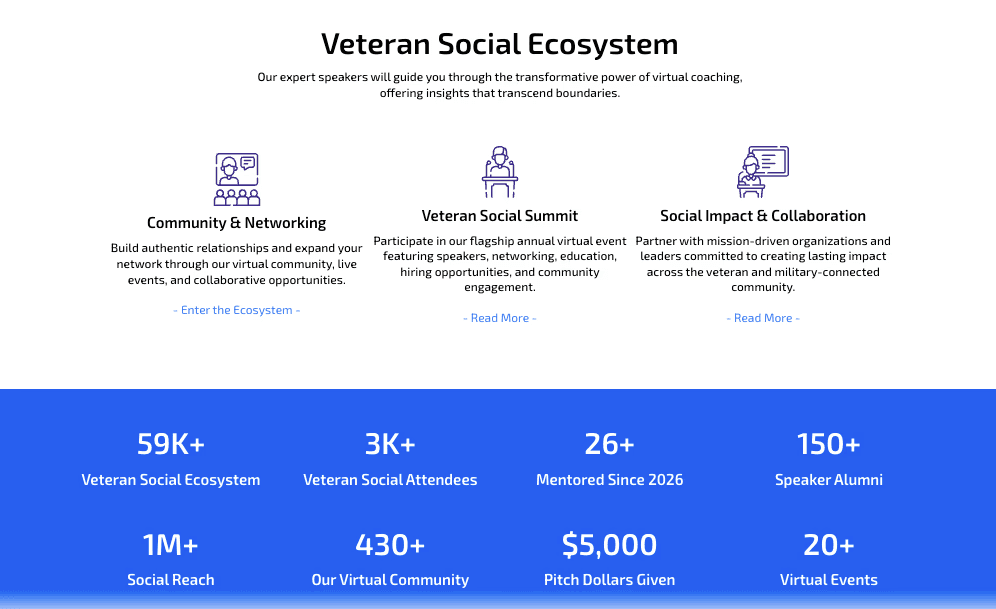
The real turning point came in 2026, when Ryan and his team realised that the impact of the annual event was capped: there was nothing holding together the relationships that were built during the conference. A veteran entrepreneur who met three peers at the September conference had no way of finding them again later on.
So Ryan's team kept circling the same question:
“Beyond just doing an annual conference, how do we keep that conversation going? How do we keep the impact rolling 24/7, 365 days a week? And then we started doing some research and we came up with the answer.”
And the decision to create an online community for Veteran Social proved to be a great one. Members love having a space where they can connect with each other, and even Ryan has been surprised by the value it's created.
Among the different spaces and initiatives inside the community, Veteran Social runs a daily co-working space. It started out weekly but proved popular enough that Ryan moved it to daily.
But the amazing thing is that these co-working sessions aren’t run by Ryan or his team - they’re run by the members.
Ryan dropped in one day to see how it was going, and at that same time someone asked who was running the show.
"I put my camera on because I was just checking in, and I said, 'I'm Ryan, I'm the founder of Veteran Social, and we're bringing this community here for you.' And he's like, 'We're very happy. I'm glad we have this space that we can all come to and exchange ideas.' And then someone in the group that's become the unofficial moderator, community manager, picked me up. He's like, 'Okay, Ryan, we got this.' And I was like, 'Wow.'"
He said he was smiling inside, thinking: this is beautiful.
That is the thing a conference cannot do: keep the impact alive all year round. Keep the connection and relationships growing.
Ryan’s Marketing Funnel: Bringing in New Members
Over the past decade, Ryan has focused on building visibility of Veteran Social and he highlights this as a key ingredient to success.
For any online coach, expert or community-builder, presence is the foundation of the marketing funnel.
“For people to find you, you need to be there for people to actually connect with you.”
Ryan does this in a number of ways:
Social media: Ryan’s strategy is a smart one. He’s not recording new content every day. Instead, he’s constantly repurposing long-form content - whether that’s from an interview he did, an event he went to, or sometimes just sitting in front of the camera and talking about a topic that his audience cares about. It doesn’t need to be perfect and it doesn’t need to be polished.
“You gotta think about it, like LinkedIn, or any of these social media channels are giving you an opportunity to sit out there and to post, you know, as many times as you want. Each of those posts is an advertisement.”
Free flagship event: the annual conference is sponsor-funded and free, which builds audience fast and gives him a natural invitation into the community afterwards. He's moved sponsors from one-off logo placements to a year-long strategic partnership cohort, and that shift is what keeps membership free.
Live activations: Ryan looks for opportunities to be present in person whether that’s at other conferences which his audience also goes to or connecting directly with members of the veteran community.
Email list: Ryan’s built out an email list of over 60k people over the past decade and this is a key part of how he invites new members into the community. He’s doing it gradually to start with but his goal is to eventually reach out to the full email list.
Why Ryan chose Swarm over Circle and Mighty Networks
When it came to choosing a platform to host a community, Ryan looked at Circle, Mighty Networks and the community feature inside GoHighLevel, in addition to Swarm.
Two factors drove his decision for choosing Swarm:
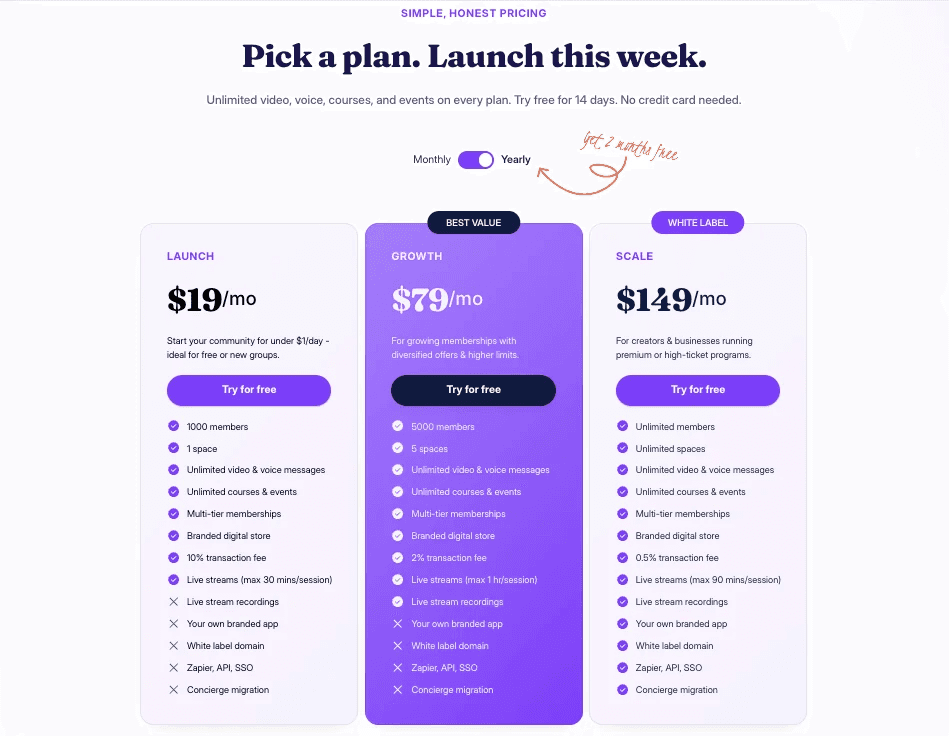
Pricing that holds up as you scale. For most community-builders, cost is a key consideration. Ryan felt that there was clear value in Swarm's pricing plans that justified upgrading as the community scales.
The member map. Ryan loved Swarm’s feature where you can visually see members plotted geographically so he can check a city before he travels to it and meet up in person with members.
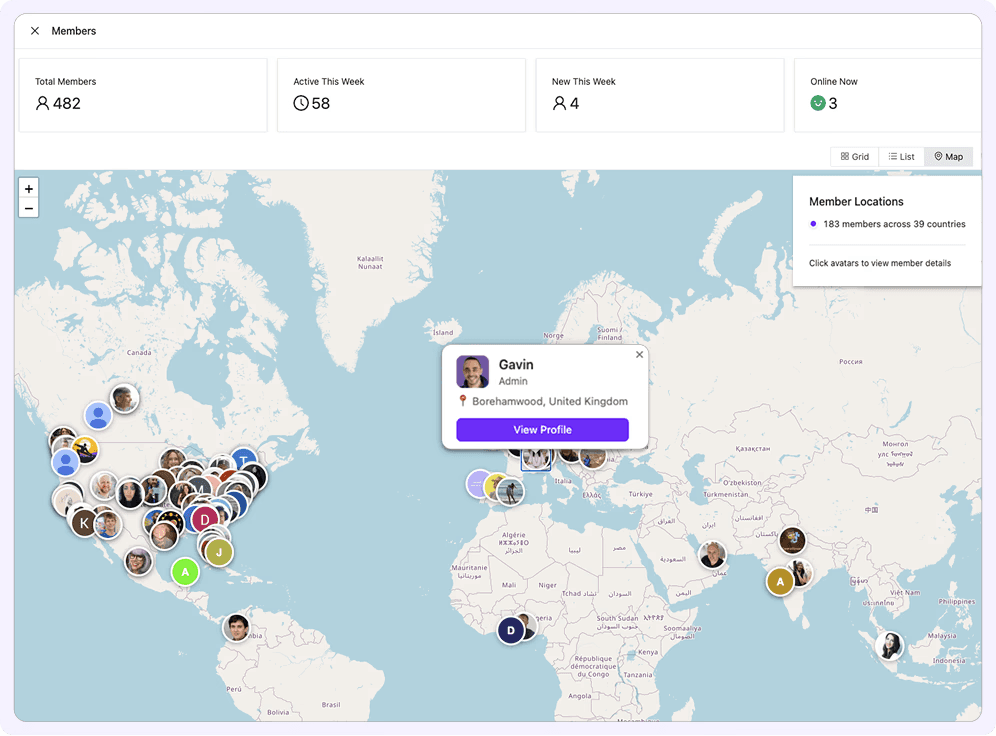
“I looked at Circle, Mighty Networks and GoHighLevel. The map sold me — I can see my whole community geographically and turn a virtual-first community into something live. And the price point as you move up in tiers is a real value proposition for what you get.”
But Ryan’s also looking at expanding his community offer with Swarm, by exploring
Live events
Courses
Higher Tier Masterminds
What's next
Within the next year, Ryan is aiming for at least 1000 engaged members. Within two years, he’s aiming for 2,000+. He also wants to start publishing free courses in the community using Swarm's course function.
The intention is to keep it accessible. There may be gated content or a higher-tier mastermind eventually, but the core community stays free as long as sponsorship allows.
Find out more about Veteran Social.
—
If you’re ready to launch an online community to keep connection & learning growing, just like Ryan, there’s a good chance Swarm might be interesting for you. Try it for yourself with a 14-day trial. No credit card required.

